
Pool heater and heat pump repair
Pool heaters come in two main types. Gas heaters burn natural gas or propane to heat the water and work in any weather. Heat pumps use electricity to move heat from the air into the water. They usually cost less to run in South Florida's warm climate, but they heat more slowly. We repair both.
Signs your heater needs attention
- It won't turn on, or it starts and then shuts itself off
- The water isn't reaching the temperature you set
- An error code or lockout appears on the display
- It cycles on and off rapidly, or makes new noises
- Water is leaking around the unit, or you see scale or corrosion on it
What we check
We start with the basics that cause most failures: water flow and the pressure switch, the thermostat and controls, and the power supply and wiring. On a gas heater we also check the igniter, the gas supply, the venting, and the heat exchanger for scale or corrosion. On a heat pump we check the fan, the evaporator coil, and the refrigerant circuit. We also look at your water chemistry, since unbalanced water scales or corrodes a heater's internal parts.
Repair or replace
If the repair is small, we fix it. If the unit is old, the heat exchanger or compressor has failed, or the repair cost is getting close to a new unit, we'll tell you and give you both numbers. A replacement is typically $5,000–$7,000 installed. The exact price depends on the heater type, the size of your pool, and any gas or electrical work involved, and we quote it before any work starts.
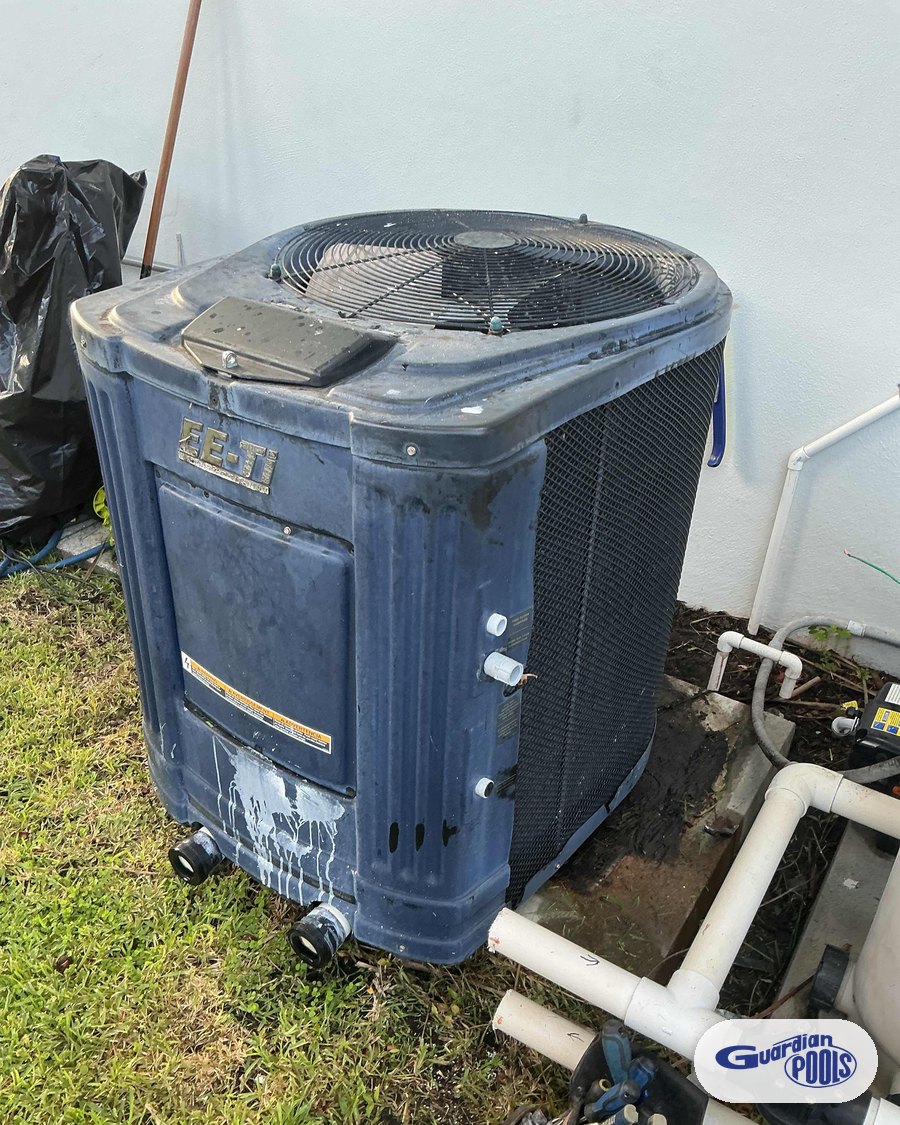
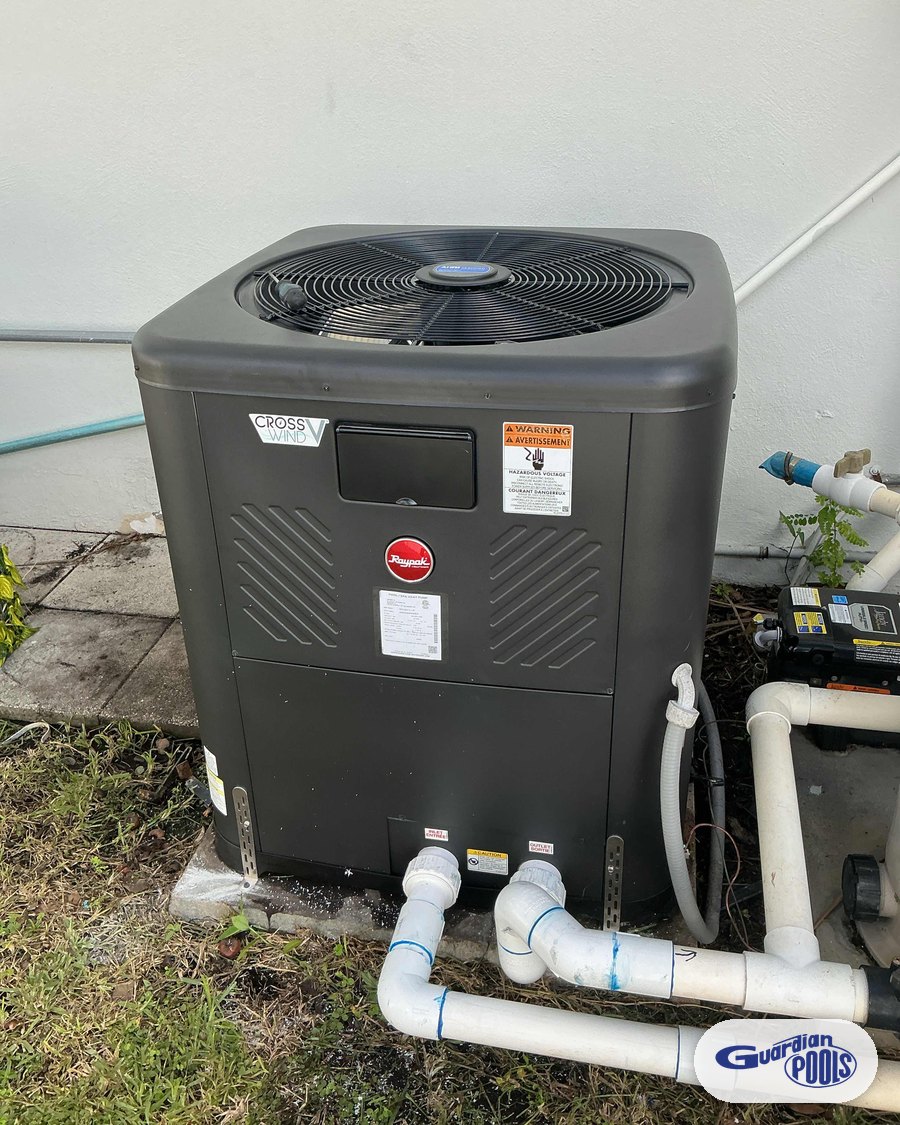
A heater replacement: the older unit on the left, and the new Raypak heat pump installed in its place.
Leak detection and plumbing repair
Pools lose water to evaporation every day in Florida's heat, so the first question is whether you actually have a leak.
The bucket test
Fill a bucket with pool water and set it on a pool step so the water inside is level with the pool. Mark the water level inside the bucket and the pool level outside it. After 24 hours, compare. If the pool dropped noticeably more than the bucket, you're losing water to more than evaporation. Running the test once with the pump on and once with it off helps point to whether the leak is in the plumbing.
Other signs of a leak
- The water level keeps dropping, or the auto-fill runs constantly
- Wet or soggy ground near the equipment or along the plumbing lines
- Air bubbles in the pump basket, or the pump losing prime
- Cracks in the shell or deck, or tile coming loose at the waterline
- A water bill that has crept up for no clear reason
How we find it
We narrow it down in stages: dye testing at fittings and cracks, pressure testing the plumbing lines, electronic listening to locate the leak, and camera inspection where needed. You get a written explanation of what we found before any repair.
Before a resurfacing
Leaks should be found and fixed before a pool is drained and refinished, otherwise the new finish goes over a problem. It's one of the items on our list of what a complete resurfacing bid should cover.
Pump and motor repair
The pump is the heart of the circulation system, and when it fails the pool goes green fast.
Common problems
- The pump won't prime or keeps losing prime (often an air leak on the suction side)
- Loud grinding or squealing, which usually points to bearings
- Water dripping from the shaft seal
- The motor hums but won't start, or trips the breaker
- Weak flow even though the filter is clean
What can be repaired
Many pump problems are repairable without replacing the whole unit: shaft seals, capacitors, bearings, impellers, lid O-rings, and unions. We tell you which problem you have, since a loud pump and a leaking pump need very different fixes.
Repair or replace
It depends on the pump's age and what the repair costs. Variable-speed pumps run slower for most of the day and use less electricity than single-speed pumps, so replacement can be worth it on an older unit. We'll give you the cost of both so you can decide.
Salt chlorine generator service
A salt system makes chlorine from the salt in your water as it passes through a cell. The cell's plates build up scale and wear out over time, which is why most salt system calls are about the cell.
- Error codes such as low salt, low or no flow, or "inspect cell"
- Low chlorine even though the system says it's running
- Diagnostics: salt level, cell condition, the flow switch, and the power supply
- Cell cleaning or replacement, depending on how worn the plates are
A salt system doesn't remove the need to test the water. pH and stabilizer still need regular attention, and on a commercial pool the chlorine residual and logs still have to meet Florida's requirements.
Filter service and replacement
We service sand, cartridge, and DE filters. A filter that isn't doing its job leaves the water cloudy and makes the pump work harder.
- Signs of trouble: pressure that climbs quickly after cleaning, short cycles between cleanings, cloudy water, or reduced flow
- Service: cleaning or backwashing, replacing sand or cartridges, and rebuilding or replacing DE grids
- Related parts: leaking valves, pressure gauges, and gaskets
Commercial pool equipment repair
On a commercial, HOA, or condo pool, equipment problems matter more because a failed pump, feeder, or controller can leave the pool out of compliance, and that can mean a closure. Health department inspectors look at the circulation and disinfection equipment, the safety equipment such as drain covers, and the records.
We repair and replace commercial pumps, filters, heaters, and chemical feed systems. Our chemical feeder guide covers what's required and the options, and our guide to the DOH inspection process explains what inspectors check. For a fast response on a commercial pool, call us directly.